- Have any questions?
- 085913 90567
- drgeorgechestdiseases@gmail.com

Is lung cancer hereditary?

Lung Nodule Biopsy: When Is It Needed and What to Expect
October 5, 2026
Incision Care After Chest Surgery: What’s Normal During Healing and When to Seek Help
October 15, 2026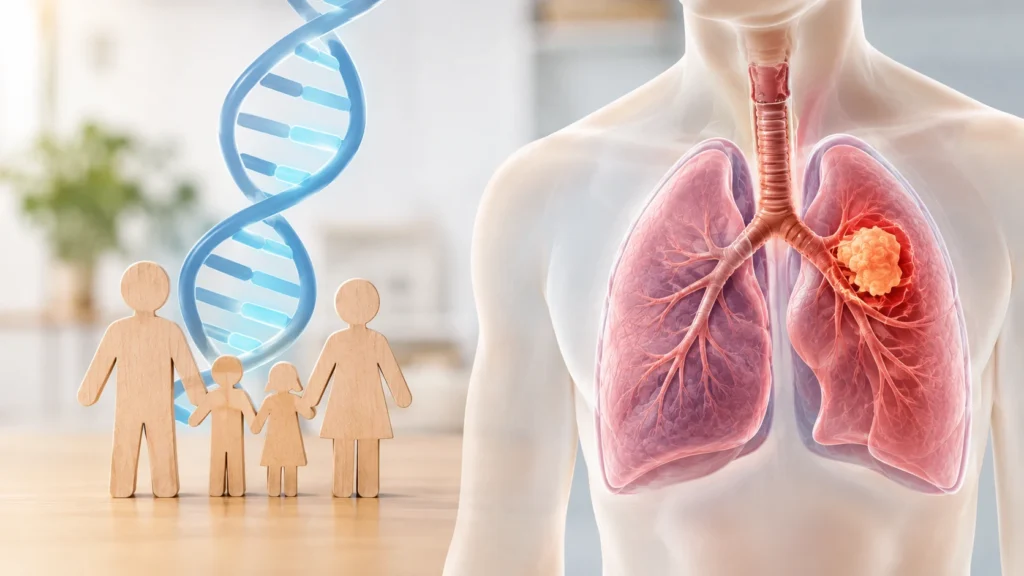
Most people brace for the wrong answer here. The thing is, lung cancer is only rarely passed down. Far more often it builds up from acquired, or somatic mutations, the wear and tear lungs collect over decades from tobacco smoke or radon exposure, rather than any gene you were born with. A family history? It nudges things, no more. The real reason of the disease sits elsewhere. And knowing which category your risk falls into, inherited or acquired, is what tells you how much of it you can actually change.
According to Dr. George Karimundackal, a Thoracic Surgeon in Mumbai, “Many patients walk in convinced that a parent’s lung cancer has sealed their own fate. The truth is gentler. Genuinely genetic cases make up only a slim minority of what we see. The bulk is down to environment, and environmental risk happens to be the kind you can work on. Once that distinction lands, fear usually gives way to sensible, preventive thinking.”
Can Lung Cancer Run in Your Family?
It can, though the part it plays is smaller than the dread suggests. Here’s what a family link really comes down to.
- Inherited gene mutations: Occasionally a faulty gene, some EGFR mutation variants included, gets passed along and lifts susceptibility. But these cases sit well outside the norm.
- Shared air, not just shared genes: Relatives usually grow up breathing the same second-hand smoke and sharing the same radon exposure, which is why inherited and environmental risk get so hard to tell apart.
- First-degree relatives: A parent or sibling with the disease roughly doubles your own odds. Then again, for a non-smoker that doubled figure is still built on a low starting point.
- When it strikes early: One telltale sign of hereditary lung cancer is its timing, showing up earlier in life and often in someone who’s never smoked. If that describes you, flag it to your doctor.
If your family history keeps nagging at you, a specialist assessment can separate genuine risk from needless worry and guide appropriate screening. You can read more about the available options for lung cancer treatment here.
What Are the Top 3 Causes of Lung Cancer?
Follow most cases back and you land on an exposure, not a bloodline. Three stand out among the lung cancer risk factors.
Cause | Relative Impact | Preventable? |
Tobacco smoke | Very high | Yes |
Radon exposure | Moderate | Largely |
Air pollution / occupational | Moderate | Partly |
- Tobacco smoke: Far and away the biggest driver, linked to around 85% of cases, and it doesn’t spare non-smokers who breathe it second-hand.
- Radon exposure: A gas you can’t smell, rising from the soil into buildings. For people who’ve never touched a cigarette, it’s the number-one culprit.
- Occupational and environmental toxins: Asbestos, diesel exhaust, long spells in polluted air. Give any of them enough years and the risk adds up.
- The common thread: Each one sparks somatic mutations in lung cells, the acquired genetic faults that get most tumours going in the first place.
Confirming a suspicious nodule still comes down to tissue, and our post on VATS lung biopsy walks through how that diagnosis gets made.
Can Lung Cancer Be Overcome?
A diagnosis today carries far more hope than it did a generation ago, thanks to earlier detection and treatment that’s moved on dramatically.
- Stage changes everything: Caught early, five-year survival can clear 60%. Found late, it falls hard, which is the whole case for screening high-risk groups.
- The toolkit has grown: Go back ten years and keyhole surgery, targeted drugs and immunotherapy simply weren’t the routine choices they are today.
- No single number fits: Survival bends to stage, cell type, general health and how the tumour responds, so any neat one-size figure deserves a raised eyebrow.
- Prevention still beats the odds: Stub out the cigarettes and test the house for radon, and you’ll cut more risk than a family history was ever going to add.
For plenty of people, beating it is realistic. What tips the balance is acting early.
Frequently Asked Questions
It can, up to a point. A close relative roughly doubles your risk, yet genuinely inherited cases remain the exception.
Tobacco smoke, radon exposure, and air pollution or occupational toxins lead the list.
There’s no fixed figure. It runs from above 60% five-year survival in early disease to a good deal lower once it spreads.
Many do, especially where it’s picked up early and treated with surgery, targeted therapy, or immunotherapy.
Disclaimer: This blog is for informational purposes only and isn’t a substitute for professional medical advice; please consult a specialist for diagnosis and treatment.