- Have any questions?
- 085913 90567
- drgeorgechestdiseases@gmail.com

Adult Tracheoesophageal Fistula: What Causes It and When Is Surgery Needed?

Chest Wall Tumors: When Is Surgery Needed?
August 1, 2026
Risks and Complications of VATS Surgery: What Patients Should Know
August 5, 2026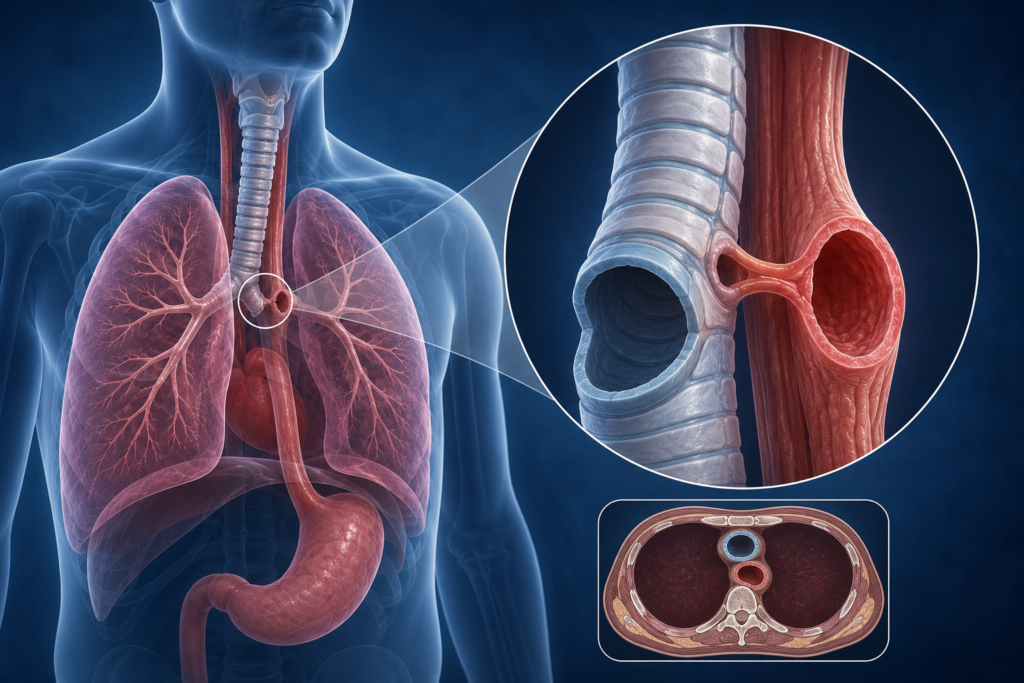
A hole between the windpipe and food pipe. That’s what TEF actually is. In adults it almost always follows a breathing tube left in too long, or a tracheostomy that never healed right. Once that opening forms, food and secretions drift into the lungs. Surgery is really the only fix that lasts. Catch it early and the operation stays simpler.
According to Dr. George Karimundackal, a leading Thoracic Surgeon in Mumbai, “Nobody walks in expecting a hole between the airway and the esophagus. It’s rare. So it gets missed. Weeks on a ventilator, then aspiration starts, and pneumonia gets blamed first. By the time someone checks for a fistula, it’s already sitting there, established. Catch it on imaging early and the surgery later is nowhere near as hard.”
What Causes Tracheoesophageal Fistula in Adults?
Adult TEF isn’t something you’re born with, not usually. A short list of causes covers nearly every case.
Prolonged intubation or tracheostomy: an overinflated cuff pressing on the tracheal wall, long enough to wear through into the esophagus sitting right behind it. By far the most common cause.
Esophageal or lung cancer: a tumor working through both structures at once. Malignant fistulas don’t behave like the benign kind, and the treatment path splits early.
Chest or neck trauma: a penetrating injury, or a tough surgery in that region. Sometimes the fistula shows up right away. Sometimes weeks pass first.
Infection or radiation damage: mediastinal infection, tuberculosis, prior radiotherapy near the neck or chest. All of it wears down the tissue between the two tubes until something gives.
That cause matters because it decides everything downstream:
|
Feature |
Benign Acquired TEF |
Malignant TEF |
|
Common trigger |
Intubation, tracheostomy, trauma, infection |
Esophageal or lung cancer invading both structures |
|
First-line approach |
Surgical repair and reconstruction |
Airway or esophageal stenting, often as the primary option |
|
Goal of treatment |
Permanent closure and cure |
Symptom control and quality of life |
|
Typical outcome |
Good long-term success in fit patients |
Guarded, tied closely to the underlying cancer |
Every one of these looks different on a scan. And none get treated the same way. Working out the cause properly is what any TEF surgery plan actually rests on.
When and How Is Adult TEF Treated Surgically?
Surgery is standard for benign acquired TEF. Malignant cases go a different route, stenting usually comes first.
Pre-operative stabilization: infection under control, nutrition sorted, ventilator weaning if that’s even possible. None of it optional before an incision gets planned.
Fistula closure and reconstruction: dividing the tract, repairing the esophageal wall, closing the tracheal defect. Often through the neck. Rarely needs the chest opened.
Muscle flap interposition: a strap muscle placed between the two repairs. Drops recurrence risk by a fair margin. Most surgeons treat this step as non negotiable.
Tracheal resection when needed: a damaged or narrowed segment gets removed outright, and the two ends get rejoined.
So this isn’t one operation. It’s several decisions, stacked. Because the airway side of TEF often overlaps with tracheal narrowing.
Why Choose Dr. George Karimundackal?
Dr. George Karimundackal is one of India’s leading thoracic surgeons with over 15 years of experience. He was previously Professor of Thoracic Surgery at Tata Memorial Hospital in Mumbai before taking up his current role as Director, Thoracic Surgery at Nanavati Max Hospital. His experience across both institutions means extensive exposure to complex airway and esophageal cases. For TEF, his approach starts with thorough pre-operative optimization and a surgical plan built around exactly where and why the fistula formed.
Getting the repair right the first time matters most here. Every consultation covers what the repair involves and what recovery looks like, before anything is decided.
Frequently Asked Questions
Pressure injury from a breathing tube or tracheostomy, most often.
Rarely on its own. Most adult cases still need surgical closure.
Mostly the neck. Chest approach is reserved for lower, complex fistulas.
Most benign cases succeed with surgery, though longer fistulas raise recurrence risk.
References
- Management and outcomes of acquired benign tracheoesophageal fistula: a single-centre experience of 58 cases: https://pmc.ncbi.nlm.nih.gov/articles/PMC12557663/
- Management of tracheo-oesophageal fistula in adults: https://pmc.ncbi.nlm.nih.gov/articles/PMC9488631/
Disclaimer: This blog is for informational purposes only and isn’t a substitute for professional medical advice; please consult a specialist for diagnosis and treatment.