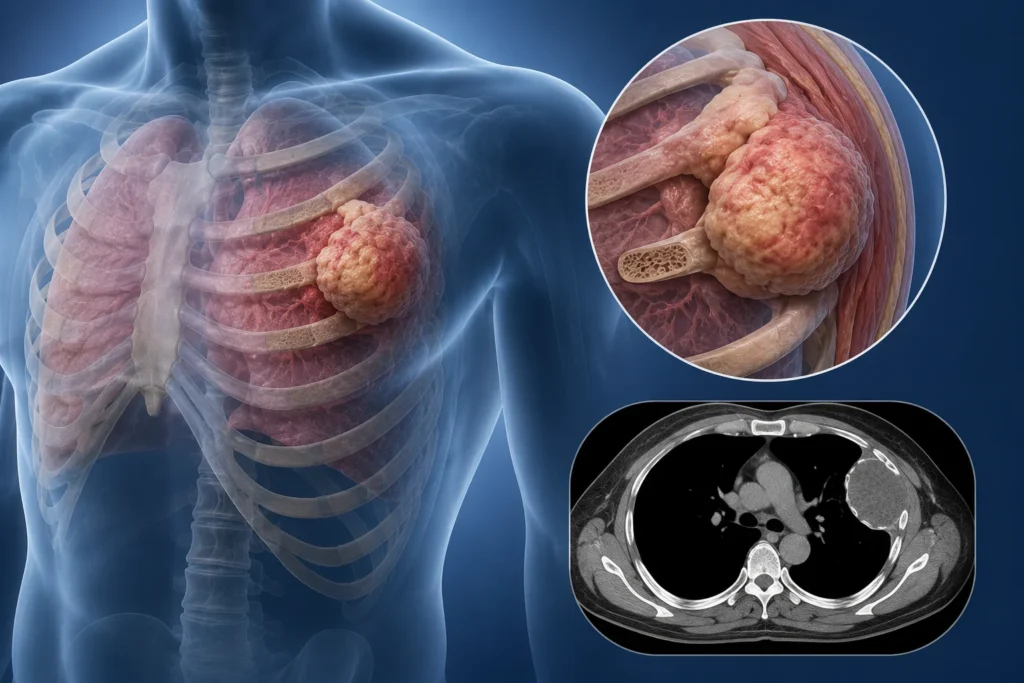
A tumor on the chest wall doesn’t always mean surgery is next. Size matters most, so does growth pattern, and whether it’s pressing into rib or sternum. Most lumps just get watched. Because they’re small, stable, not going anywhere. Growing ones, painful ones, anything sitting near bone, usually need a surgeon’s opinion soon.
According to Dr. George Karimundackal, a leadingThoracic Surgeon in Mumbai, “Patients often wait because the lump doesn’t hurt. That’s the wrong signal to go by. Size and location on imaging tell us far more than pain ever will. Once a chest wall mass is growing, or sitting close to the sternum, surgical planning shouldn’t wait.”
What Causes a Chest Wall Tumor and How Is It Diagnosed?
Chest wall lumps can arise from bone, cartilage, muscle, or sometimes from cancer that has spread from another part of the body. Sometimes they’ve spread in from elsewhere in the body. Diagnosis depends on imaging and biopsy, not how something feels to the touch.
Primary bone or cartilage tumors: these start right in the ribs, sternum, or costal cartilage. Some are benign. Some aren’t. And imaging alone often can’t tell you which.
Metastatic deposits: tumors that traveled in from breast, lung, kidney, or thyroid cancer somewhere else in the body. More common than most people assume.
Soft tissue tumors: sarcomas, lipomas, desmoid tumors growing out of muscle or fibrous tissue near the ribs. Easy to miss on a plain X-ray.
Inflammatory or infective masses: rib osteomyelitis or a cold abscess can look just like a growth. Imaging and a biopsy sort out which is which.
CT chest with contrast comes first, always. MRI adds detail on soft tissue when needed. A core needle biopsy confirms what’s actually growing before any surgical decision gets made. Every chest wall lump starts here: a proper workup before any discussion of chest wall surgery.
When Does a Chest Wall Tumor Actually Need Surgery?
Not every mass on the chest wall needs an operation. Several things push the decision toward surgery though, and fast.
Malignant or suspicious biopsy: confirmed or strongly suspected cancer goes to surgery. Wide margins, usually, to keep it from returning.
Growing benign lesions: a mass that keeps enlarging on repeat scans gets removed before it starts pressing on nerves or vessels. Even benign ones.
Compression of nearby structures: a tumor big enough to push on the lung, nerves, or major vessels. Breathlessness or numbness from a mass tips the balance toward operating.
Pain, deformity, or cosmetic concern: persistent localized pain, or a deformity that’s visibly getting worse. Reason enough on its own to talk about tumor excision, malignant or not.
So really, it comes down to what the biopsy and scans show. Not a single rule of thumb. Every chest lump gets its own workup, never a generic answer. More on howtumor surgery decisions get made for masses elsewhere in the chest.
Why Choose Dr. George Karimundackal?
Dr. George Karimundackal has spent over 15 years as Director of Thoracic Surgery at Nanavati Max Super Speciality Hospital, Mumbai. Before that, he was Professor of Thoracic Surgery at Tata Memorial Hospital, which meant years of exposure to complex chest wall and mediastinal cases well before private practice. His approach to chest wall tumors surgery pairs careful imaging review with a resection and reconstruction plan built around each patient’s own anatomy. Bone or cartilage removal cases go through a wider surgical team, plastic surgeons included where reconstruction is needed. That planning matters more here than in most other thoracic procedures.
Removing the tumor is only half the job. Rib cage stability and normal breathing afterward count for just as much, and that only comes from experience handling both sides of it. Patients know exactly what reconstruction, if any, will involve before surgery gets booked.
Frequently Asked Questions
Is every chest wall tumor cancerous?
No. Many lumps are benign, but biopsy confirms it either way.
Does every chest wall tumor need surgery?
No. Small stable benign ones can be monitored. Growing or painful masses need surgery.
What imaging is used to diagnose a chest wall mass?
CT chest with contrast first, sometimes MRI, then a core needle biopsy.
How long is recovery after chest wall tumor surgery?
Most patients go home within a week, back to routine in about a month.
Disclaimer: This blog is for informational purposes only and isn’t a substitute for professional medical advice; please consult a specialist for diagnosis and treatment.