- Have any questions?
- 085913 90567
- drgeorgechestdiseases@gmail.com

Esophageal Cancer Surgery: What Are the Main Types to Know?

Recovery After an Esophagectomy: What Is It Really Like?
November 9, 2026
Does Pneumothorax Need a Chest Tube or Needle Aspiration?
November 13, 2026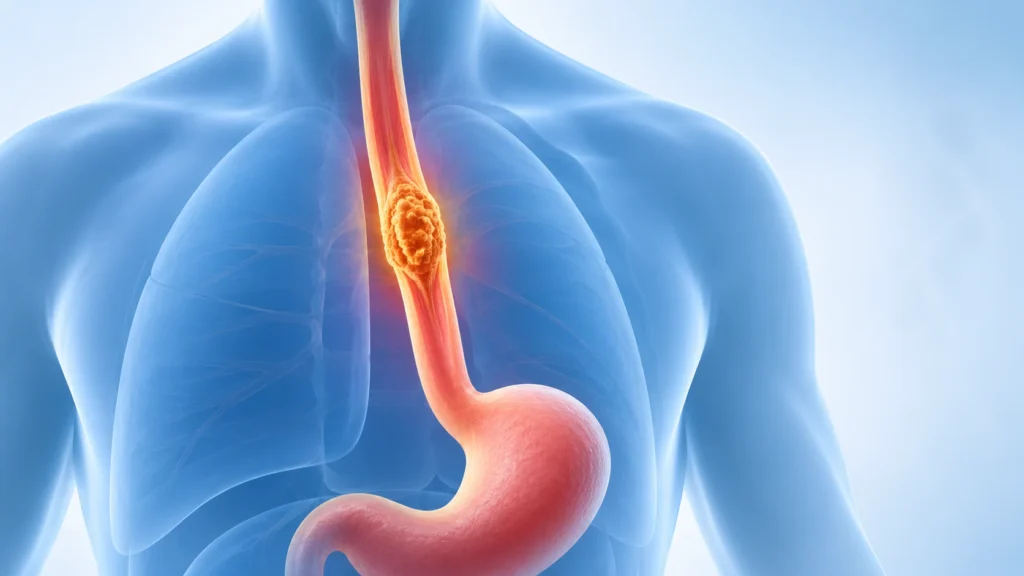
Esophagectomy is the main curative operation for esophageal cancer. It cuts out a section or the entire esophagus, and reconstructs the digestive system, typically using a portion of the stomach or intestine. But that’s not the only operation. Surgery for esophageal cancer can be either a small procedure called endoscopy for very early disease or large resections. Not all cancers are created equal, and not all surgeries are.Not all cancers are alike, and not all surgeries are.
According to Dr. George Karimundackal, a Thoracic Surgeon in Mumbai, “The choice of operation depends on where the tumor sits, how deep it has grown and how fit the patient is. No single surgery suits everyone, so the plan is built around the person rather than the procedure.”
What Are the Different Types of Surgery for Esophageal Cancer?
The two most prevalent types are squamous cell and adenocarcinoma, which may require surgery depending on location and stage.
- Endoscopic mucosal resection: In very early tumors, where the growth is confined to the inside, a scope is used to take out the abnormal tissue without making any cuts on the outside.
- Esophagectomy: This is the primary curative surgery, which involves removing the esophagus and reconnecting the food passage, primarily for cancers of the middle and lower esophagus.
- Surgery following chemotherapy or radiotherapy: In most cases, cancers that have spread to nearby lymph nodes are treated with chemotherapy or radiotherapy first, and then surgery.
- Palliative stent placement: If cure is not possible, a stent keeps the esophagus open making swallowing easier.
Details of diagnosis, staging and treatment planning are on the esophageal cancer treatment page.
What are the 3 types of esophagectomy?
The names are not from anatomy, but from surgeons, thus confusing almost everyone.
|
Type |
Incisions |
Where the new join sits |
|
Transthoracic (three-field) |
Chest, abdomen and neck |
Neck |
|
Ivor Lewis |
Abdomen and right chest |
Chest |
|
Thoracoabdominal |
One cut across chest and abdomen on left side |
Chest |
- Transthoracic (three-field): Three incisions provide generous access, and a join in the neck is easier to deal with should there be a leak.
- Ivor Lewis: The stomach tube is joined to the esophagus inside the chest, a common pick for lower esophageal cancers.
- Thoracoabdominal: A single left-sided approach, usually kept for cancers in the lower esophagus or where it meets the stomach.
- Keyhole and robotic versions: There are also small cuts with a camera and robotic versions of each route, which can help reduce pain and lung issues.
If you’re interested in one of these operations, check out this post on minimally invasive esophagectomy.
Can Esophageal Cancer Surgery be dangerous?
Yes, it is a major surgery and there is the possibility of complications. However, the risk is not the same for everyone, and careful planning reduces the risk.
- Leak at the join: The new connection may leak in some patients, so it is closely monitored during the first week.
- Chest and lung issues: Pneumonia is a frequent concern following open surgery, and keyhole and chest physiotherapy help minimise this.
- Swallowing and voice changes: Narrowing at the join or irritation of a nerve near the voice box can occur in a few patients.
- Personal risk: Age, fitness, heart and lung health, and the location of cancer are all different for each person, and a team checks before an operation is planned.
This guide on how to care for your incision after chest surgery includes warning signs following discharge. Don’t wait until it’s too late to call if something doesn’t feel right.
Key Takeaways: Esophageal cancer surgery ranges from a small procedure where the tumor is removed endoscopically, to a complete removal of the esophagus, which is known as an esophagectomy, and is performed in three major ways. The decision will be influenced by stage and the location of the cancer and risks are real but manageable with planning and follow-up. Ask questions early.
Frequently Asked Questions
Squamous cell and adenocarcinoma.
Yes, very early tumors can be removed endoscopically via the mouth.
No, not all early cases will require it, but larger cases will typically do.
Yes, the main approaches can be done by VATS or robot.
References
- Robot-assisted Ivor Lewis Esophagectomy (RAILE): A review of surgical techniques and clinical outcomes. Front Surg. 2022;9:998282. https://pmc.ncbi.nlm.nih.gov/articles/PMC9672456
- Fransen LFC, Luyer MDP. Effects of improving outcomes after esophagectomy on the short- and long-term: a review of literature. https://pmc.ncbi.nlm.nih.gov/articles/PMC6503271
Disclaimer: This blog is for educational and informational purposes only and should not be considered professional advice.