- Have any questions?
- 085913 90567
- drgeorgechestdiseases@gmail.com

Does Pneumothorax Need a Chest Tube or Needle Aspiration?

Esophageal Cancer Surgery: What Are the Main Types to Know?
November 11, 2026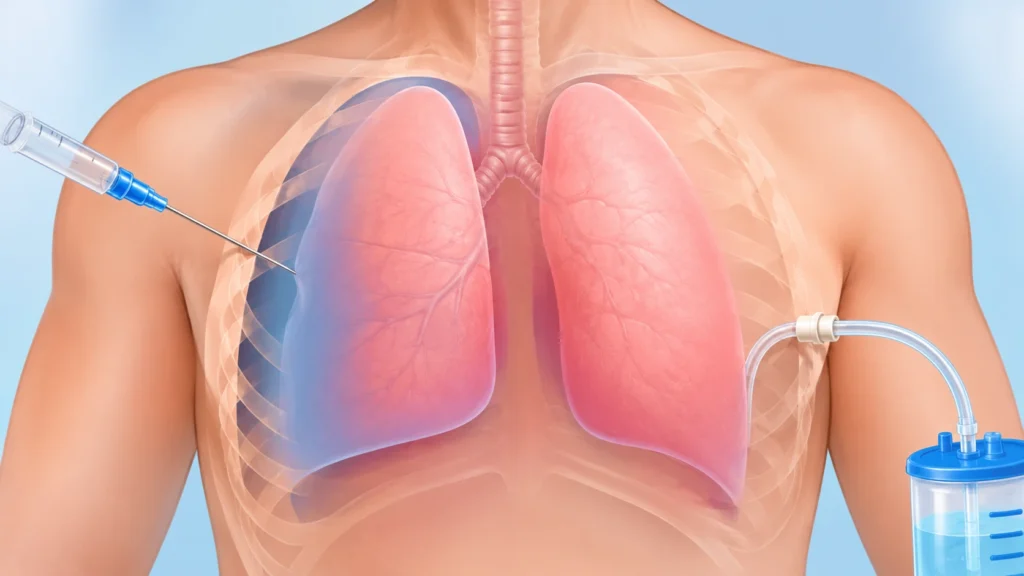
Symptomatic collapsed lung (pneumothorax) is usually treated with either needle aspiration or chest tube drainage. They vary in their invasiveness, length of hospital stay and their first time effectiveness. Needle aspiration is performed with a thin needle or catheter, and takes only minutes. A chest tube remains in place for several days. Needle aspiration is not a competition with chest tube. These are for different scenarios.
According to Dr. George Karimundackal, Thoracic Surgeon in Mumbai, “Both procedures remove air from the chest, but they are not interchangeable. Needle aspiration suits a young, stable patient with a first collapse and healthy lungs. A chest tube is kept for larger collapses, lung disease, injury, or when aspiration hasn’t worked. The choice is made case by case, after looking at the imaging and at how the patient is breathing.”
How Is Needle Aspiration Done, and Where Is It Placed?
Needle aspiration is done at the bedside under local anaesthetic. The majority are 15 to 30 minutes long.
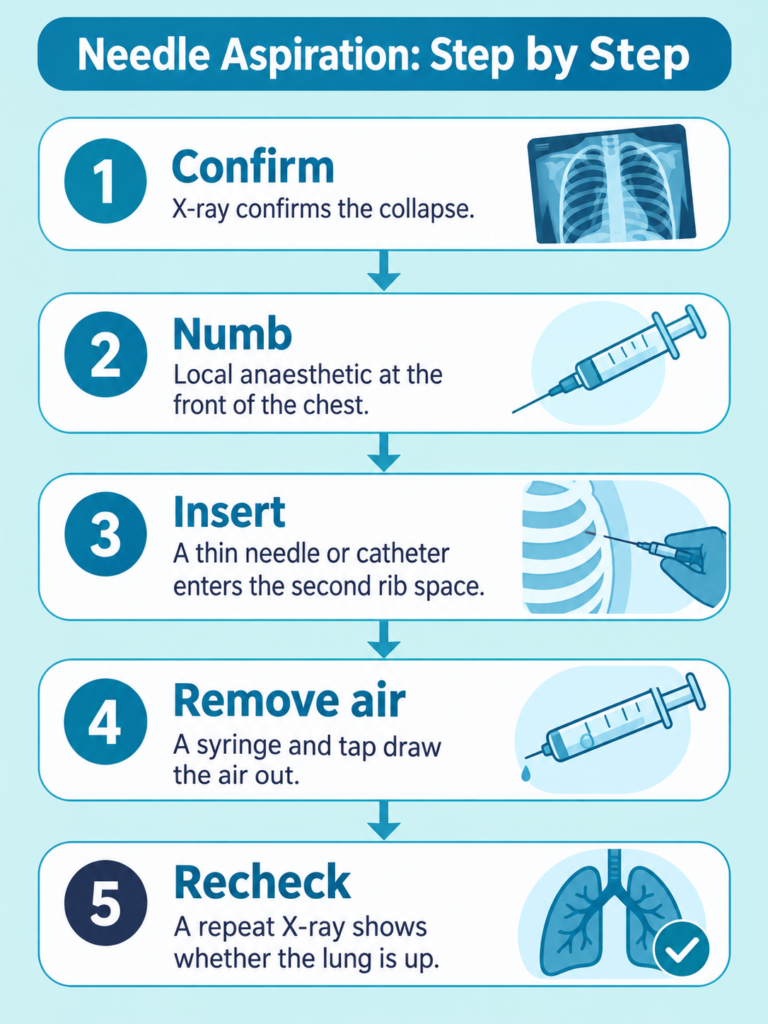
- Where it is placed: in most patients the needle goes in at the front of the chest, through the second rib space, roughly in line with the middle of the collarbone. It runs just over the rib below that. The nerve and blood vessels are located underneath the rib above, so this way the needle stays away from them.
- The 2 cm rule: a chest X-ray is used to measure the distance between the edge of the lung and the chest wall at the level of the hilum, which is 2 cm. Large pneumothorax is defined as a gap of ≥ 2 cm. Below this, the patient may be monitored without treatment. Newer guidelines are based more on symptoms than on size.
- Who it suits: the typical candidate is a young, stable person with a first primary collapse and otherwise healthy lungs. It’s not as good an option for a secondary pneumothorax because there’s not much left to lose with an underlying lung disease.
- When it doesn’t work: sometimes the lung won’t come back up, or the air keeps returning. This is followed by a chest tube. In one randomized trial, about one-third of aspirations were of this type.
Additional information about when each of these options is recommended is provided in the pneumothorax treatment guidelines.
Needle Aspiration vs Chest Tube: What's the Difference?
The two procedures are shown side by side
|
Feature |
Needle Aspiration |
Chest Tube Drainage |
|
Invasiveness |
Thin needle or catheter, removed once the air is out |
Tube left in the chest for several days |
|
Usual site |
Front of the chest, second rib space |
Side of the chest, fourth or fifth rib space |
|
Usually used for |
A first primary collapse in a stable person |
Large or secondary collapses, chest injury, ventilated patients, or a failed aspiration |
|
First-attempt success |
Roughly 50 to 70 percent |
Works in most cases |
|
Hospital stay |
Often shorter, and sometimes none |
Longer, usually a few days |
- Aspiration is a planned procedure: Needle decompression is the emergency measure, used for tension pneumothorax, where air under pressure is pressing on the heart. A large needle is inserted at once to release it and then a chest tube is inserted. Aspiration is different. It is planned and the patient is stable.
- Trials give mixed results: some pooled analyses find chest tubes work first time more often. Others see little difference, and have comparable recurrence rates at one year. The tendency to think that the larger procedure is the safer procedure is a common one. In many first episodes, the smaller one does just as well.
- The difference in pain and side effects: Aspiration is gentler, less pain and fewer side effects. A tube is not always comfortable and sometimes it can block or become infected with bacteria at the point of entry, but this is not a common occurrence.
- Both don’t stop the collapse from returning: the collapse returns at similar rates after either procedure. Surgery reduces that risk significantly.
This post on emergency warning signs covers signs that require immediate attention.
Does Every Pneumothorax Need a Chest Tube?
No. A chest tube for pneumothorax is only used in a few cases, and is ordered along a sort of “ladder”.

- A drainage bottle with water seal: this tube is attached to a bottle that will allow air to escape but not enter. If it bubbles, there is still air leaking from the lung. If there is no bubbling when it stops, then it is a good sign.
- A small tube is typically used: doctors will first attempt a small-bore tube, which is approximately 10 to 14 Fr (width). It is easier to use and is in most cases as effective as a larger one. Blood or pus is collected in larger tubes.
- Removal: When there is no more bubbling and an X-ray confirms that the lung is fully inflated, the tube is removed. This typically takes 2-5 days.
- A leak that persists: If air is still leaking after five to seven days, a surgical opinion is advised.
If there is a leak or the collapse recurs, the next option is to consider VATS surgery.
Key Takeaways: Both procedures are used to get air out of a collapsed lung. The smaller of the two is needle aspiration and is frequently used for a first primary collapse in a stable patient. Chest tube used for larger or secondary collapse, chest injury, and in the event of aspiration failure. Both are unable to prevent a collapse from recurring and repeated collapses often result in a discussion of surgery.
Frequently Asked Questions
A chest tube is used to drain air for days while decompression is an emergency one-off procedure.
A gap of 2cm or more is large on X-ray.
Typically on the second rib space at the front of the chest.
No. Small ones are usually just observed and many first episodes require only aspiration.
References
- Needle aspiration versus tube thoracostomy in patients with symptomatic primary spontaneous pneumothorax: an updated meta-analysis of randomized controlled trials (PMC): https://pmc.ncbi.nlm.nih.gov/articles/PMC11228703/
- Randomized controlled trial on the comparison of chest tube drainage and needle aspiration in the treatment of primary spontaneous pneumothorax (PMC): https://pmc.ncbi.nlm.nih.gov/articles/PMC6290202/
Disclaimer: This blog is for educational and informational purposes only and should not be considered professional advice.