- Have any questions?
- 085913 90567
- drgeorgechestdiseases@gmail.com

What Is Pectus Excavatum and How Is It Fixed?

Why Do I Cough Every Time I Eat or Drink? Could It Be a Fistula?
August 7, 2026
What Is a Pneumothorax (Collapsed Lung)? Causes and Emergency Signs
August 11, 2026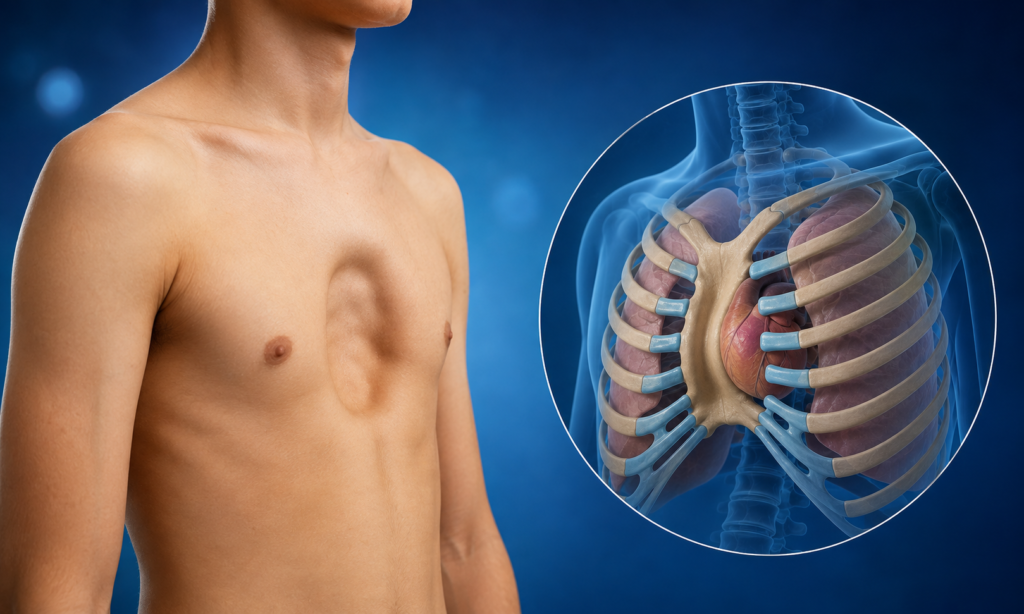
A dip in the middle of the chest, where the breastbone caves inward instead of sitting flat. That’s pectus excavatum. It’s the most common chest wall condition people are born with, showing up in roughly 1 in 300 to 400 births. Some barely notice it. In others the sternum sits low enough to crowd the heart and lungs, and exercise is the first thing to suffer. Correction is possible, and how it’s done comes down to how deep the dip actually runs.
According to Dr. George Karimundackal, a leading Thoracic Surgeon in Mumbai, “A lot of patients turn up convinced this is purely a cosmetic thing. Plenty of the time, it isn’t. Let the sternum sink far enough and it starts crowding the heart and holding the lungs back from filling the way they should. So we look past the dent itself. Depth, symptoms, age, what it actually stops someone doing. Then we fix that.”
What Causes Pectus Excavatum?
This isn’t something that shows up out of nowhere in adulthood. It’s present at birth, even when the dip doesn’t get noticed until years later. What actually triggers it in the first place? Still not fully worked out.
Cartilage overgrowth: the cartilage joining each rib to the breastbone grows more than it should. That extra tissue pushes the sternum inward over time. Most cases trace back to exactly this.
Genetic link: this tends to run in families. About 4 in 10 patients have a relative with the same chest shape. So heredity plays a real part here, not just chance.
Connective tissue disorders: Marfan syndrome and Ehlers-Danlos raise the odds considerably. Loose supporting tissue gives the chest wall less to hold its shape against, so it folds inward more easily.
Teenage growth spurts: a mild dip can deepen fast through puberty. The chest stretches, the hollow follows. Rarely on any schedule.
How deep that dip runs decides almost everything downstream:
|
Feature |
Mild Pectus Excavatum |
Severe Pectus Excavatum |
|
Chest appearance |
Shallow dip, mostly cosmetic |
Deep hollow, sternum pressing inward |
|
Impact on heart and lungs |
Minimal |
Heart pushed aside, lung volume drops |
|
Usual symptoms |
Mostly about appearance |
Getting winded, tiring quickly, chest pain when active |
|
Usual approach |
Observation, posture work, vacuum bell |
Surgical correction, Nuss or Ravitch |
Every dip looks different on a scan, and none get treated the same way. Working out the severity properly is what any chest wall surgery plan actually rests on.
How Is Pectus Excavatum Corrected?
No two chests end up with the same plan. The approach tracks the severity and the patient’s age.
Nuss procedure: a curved metal bar slides under the sternum through two small side cuts and lifts it forward. Minimally invasive, no scar down the front. The bar stays two to three years, then it’s out.
Ravitch procedure: the open route. Here the overgrown cartilage is taken out and the breastbone reset back into position by hand. Usually reserved for asymmetric or complex chests. Bigger operation, but it holds.
Vacuum bell therapy: no cutting involved. A suction device pulls the chest outward gradually, over months. Works best in younger patients, chests that still have some flexibility left, and dips that haven’t gone too deep.
Physiotherapy and observation: some mild cases just need posture work and regular follow-up. Nothing more than that. Not everyone lands in the operating theatre. Surgery is a choice made deliberately, never the automatic next step.
So this isn’t one operation, it’s several decisions stacked on top of each other. And because chest wall repair shares ground with other procedures inside the chest, our read on thymoma surgery shows how we weigh that kind of call.
Why Choose Dr. George Karimundackal?
Dr. George Karimundackal has put in over 15 years in thoracic surgery, currently as Director of Thoracic Surgery at Nanavati Max Super Speciality Hospital, Mumbai. Before that, Professor of Thoracic Surgery at Tata Memorial Hospital, where chest wall and complex thoracic cases came through in volumes most surgeons never see. For pectus excavatum, he selects the appropriate technique (Nuss, Ravitch, or a conservative approach) based on precise measurements and imaging.
Because the dip sits directly over the heart and lungs, steady judgment counts for far more than speed. What actually sets this apart: thorough pre-operative imaging, and a recovery plan built around real pain control plus getting patients moving early. Most walk out standing straighter, breathing easier, and carrying a lot less worry than they brought in.
Frequently Asked Questions
Mild cases cause no harm. Deep ones can press on the heart and lungs.
Usually between 12 and 18, while the chest wall still bends easily.
Some discomfort for weeks. Pain control and early movement ease it.
Recurrence is rare when the right technique and timing are used.
References
- NCBI StatPearls (NIH): Pectus Excavatum: https://www.ncbi.nlm.nih.gov/books/NBK430918/
- PMC (NIH): Systematic review of physiological and psychological outcomes of surgery for pectus excavatum: https://pmc.ncbi.nlm.nih.gov/articles/PMC10582895/ PubMed Central
Disclaimer: This blog is for informational purposes only and isn’t a substitute for professional medical advice; please consult a specialist for diagnosis and treatment.