- Have any questions?
- 085913 90567
- drgeorgechestdiseases@gmail.com

Surgery vs Radiation: Which for Early Stage Lung Cancer?

What Is Tracheal Stenosis and How Is It Treated?
July 4, 2026
Robotic Surgery vs VATS: Which for Esophageal Cancer?
July 11, 2026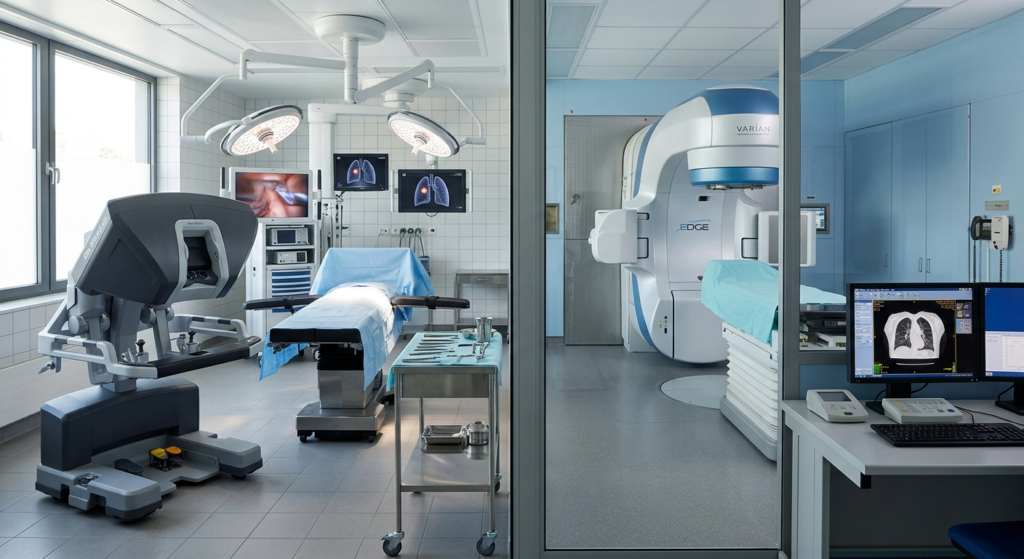
Fit patients get surgery. That’s the short answer for early stage lung cancer. Radiation, mainly SBRT, comes in for people who can’t safely go through an operation. Not a choice made on preference. Lung function, heart health, overall fitness decide which path a patient is even offered.
According to Dr. George Karimundackal, a leading Thoracic Surgeon in Mumbai, “Some patients ask for radiation because it sounds gentler. Wrong way to think about it. Surgery takes out the tumour and the lymph nodes around it in one go, and that combination is still what gives the best numbers years later. Radiation has its place, for people who genuinely can’t handle an operation. It’s not a softer option for everyone.”
Surgery vs SBRT for Early Stage Lung Cancer at a Glance
|
Surgery |
SBRT (Radiation) |
|
|
Best suited for |
Fit patients, good lung function |
Medically inoperable patients |
|
Removes lymph nodes |
Yes |
No |
|
Sessions required |
One procedure |
3 to 5 sessions |
|
Recovery time |
2 to 6 weeks depending on approach |
Days |
|
Long term survival data |
Stronger, larger evidence base |
Growing, still maturing |
Why Is Surgery Still the Standard for Early Stage Lung Cancer?
Cutting the tumour out with a margin of healthy tissue gives pathologists something radiation never can, a direct look at whether cancer has already reached the lymph nodes.
- Lymph node clearance. Surgery pulls out mediastinal nodes for direct examination. Cancer cells in nodes that looked clean on a scan changes everything about what comes next.
- Decades of data behind it. Stage IA resections at busy surgical centres run five-year survival somewhere between 84 and 95 percent. That’s not a new number, it’s built on years of tracked outcomes.
- Recovery has gotten shorter. VATS and robotic techniques cut down the gap between surgery and radiation considerably. Weeks now, not months, for most people to get back to normal.
- Fitness decides more than the tumour size does. Bad COPD, weak heart reserve, advanced age stacked with other conditions, any of these can push a small, early tumour toward radiation instead of surgery.
Surgery earns its standing because it does two jobs at once, removes the cancer and tells you exactly how far it has spread. Anyone weighing this option should start with a proper look at lung cancer treatment before deciding anything.
When Does Radiation Become the Better Choice?
SBRT isn’t a fallback for people who can’t handle surgery. It’s a different tool built for a different situation, and for the right patient it works well.
- Genuinely inoperable patients. Severe lung disease, serious heart problems, real frailty, situations where the surgery risk outweighs what it might fix.
- Local control holds up. Research show tumour control comparable to surgery for early stage disease, especially tumours under 3cm.
- Days, not weeks, to recover. No incision, no hospital stay. That matters just as much as the cancer itself for an elderly or frail patient.
- Some choose it even when eligible for surgery. Once someone understands the trade off, mainly the lack of lymph node assessment, a few still decide SBRT is the right choice for them.
SBRT delivers precise, high dose radiation across just 3 to 5 sessions with no cutting involved, and it’s closed a lot of the gap that used to separate it from surgery. For a clearer sense of how outcomes stack up stage by stage, lung cancer survival rates by stage breaks it down properly.
Why Choose Dr. George Karimundackal?
Dr. George Karimundackal, MBBS, MS (General Surgery), MCh (Surgical Oncology), MRCS Edinburgh, is Director of Thoracic Surgery at Nanavati Max Super Speciality Hospital, Mumbai. Over 15 years working exclusively in thoracic surgery, more than 1,000 minimally invasive procedures behind him. He looks at every early stage case on its own terms rather than pushing one treatment path by default. Every patient goes through a proper multidisciplinary tumour board that includes radiation oncology, so the surgery versus radiation call gets made with the full picture in front of everyone.
Frequently Asked Questions
For patients fit enough for it, surgery remains the standard because it removes the tumour along with surrounding lymph nodes. Radiation is used mainly when surgery is not medically safe.
Stereotactic body radiation therapy delivers high dose, precisely targeted radiation over a few sessions. It is used for early stage tumours in patients who cannot undergo surgery.
SBRT can achieve strong local tumour control in early stage disease, though surgery still offers better long term survival data in operable patients.
Patients with severe COPD, poor lung function, or major heart disease that makes surgery too risky are usually directed toward radiation instead.