- Have any questions?
- 085913 90567
- drgeorgechestdiseases@gmail.com

Bronchiectasis Surgery: When Is It an Option?

Lung Cancer Screening: Who Should Get a Low-Dose CT Scan?
September 15, 2026
Minimally Invasive Esophagectomy: What to Expect?
September 26, 2026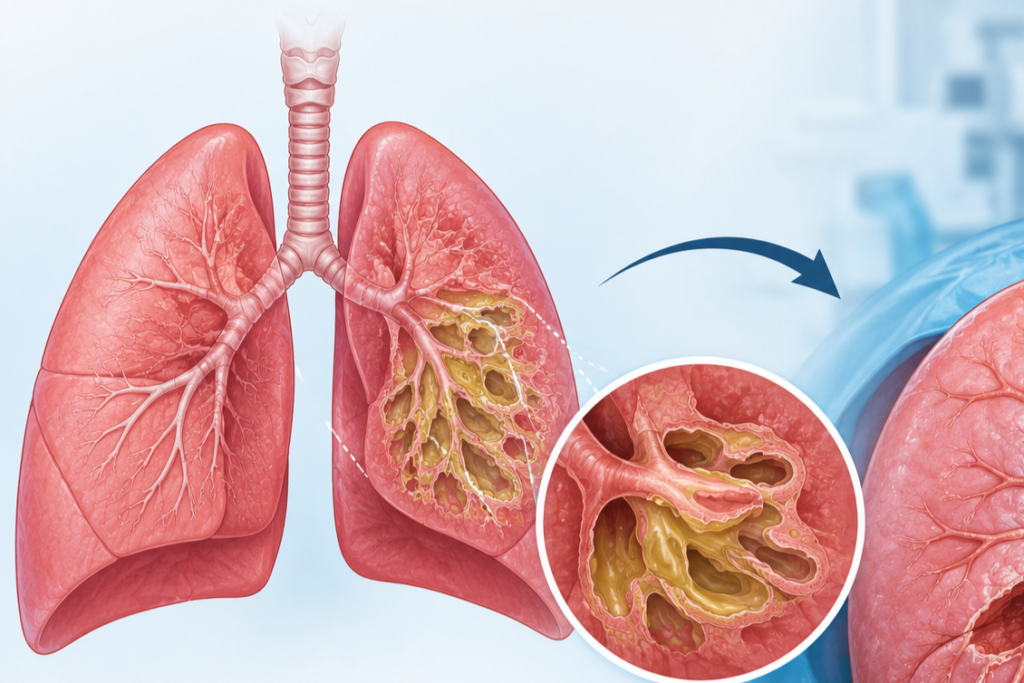
Bronchiectasis scars the airways permanently. That part can’t be undone. For the vast majority of patients, treatment is about managing what’s there, keeping infections under control, and slowing things down. Bronchiectasis surgery treatment comes into the picture only when disease is sitting in one lobe or segment, and a proper course of medical management has already been tried and hasn’t worked. Once the damage has spread across both lungs, operating doesn’t help. There’s no good lung left to protect.
According to Dr. George Karimundackal, a Thoracic Surgeon in Mumbai, “Surgery for bronchiectasis is one of the most carefully selected decisions in thoracic practice. You need localised disease, adequate remaining lung function, and a clear reason the medical route hasn’t worked. Get the patient selection right, and the outcomes are genuinely good. Get it wrong, and you operate on someone who needed better medical management, not a resection.”
Who Actually Qualifies for Bronchiectasis Surgery?
Few bronchiectasis patients end up in the operating theatre. Strict criteria exist for good reason, because the window for benefit is narrow.
Localised disease confirmed on HRCT: surgery makes sense only when the damaged airways are confined to one lobe or segment. A high-resolution CT identifies exactly where the disease sits. That one scan drives most of what follows in the surgical plan.
Persistent symptoms despite optimal medical treatment: proper airway clearance, antibiotics through exacerbations, and a genuine run of pulmonary rehabilitation, and the patient still isn’t improving. That’s the threshold where a surgical opinion becomes appropriate.
Recurrent or severe haemoptysis: bleeding that bronchial artery embolisation hasn’t been able to hold back is unlikely to respond to more medication. Surgery removes what’s causing it. Not a patch, a solution.
Recurrent pulmonary infections in the same segment: when the same lobe keeps getting infected every year despite everything, the anatomy itself is the problem. That segment is functioning as a reservoir, and medical management has no way to fix that structurally.
Most patients never need an operation, and managing them well without surgery is absolutely achievable. The full range of bronchiectasis treatment options covers symptom control, exacerbation management, and quality of life without any of it involving a theatre.
What Does Bronchiectasis Surgery Involve and What Can Patients Expect?
Surgery follows the disease, not a fixed template. Where the cavity sits and what surrounds it shapes the approach before anything else.
Lobectomy or segmentectomy: the damaged lobe or segment comes out, most often through VATS. Something patients don’t often hear beforehand: published series show VATS converting to an open approach in roughly a quarter to a third of cases. Dense adhesions from years of repeated infection are the usual reason. Keyhole access stops being safe, not just less convenient.
Pre-operative optimisation: lung function is assessed carefully before a surgical date is set. Quite a few of these patients are already in respiratory physiotherapy. Some need nutritional support or an infection control course before the operation. That groundwork genuinely shifts how things go.
What surgery does and doesn’t fix: in well-selected patients, bronchiectasis surgery treatment reduces exacerbation frequency, stops haemoptysis, and removes the infected segment. What it doesn’t do is cure the underlying condition, or protect whatever lung tissue remains from future disease.
Recovery: home within five to seven days after a VATS resection for most patients. Chest physiotherapy continues post-operatively, picking up the airway clearance routine and reducing the risk of complications from secretions that can’t clear on their own.
If you’re working out how bronchiectasis differs from other structural lung diseases, our post on bronchiectasis vs emphysema breaks down the differences in cause, presentation, and what treatment actually targets.
Why Choose Dr. George Karimundackal?
Dr. George Karimundackal is one of India’s leading thoracic surgeons with over 15 years of experience. He was previously Professor of Thoracic Surgery at Tata Memorial Hospital in Mumbai before taking up his current role as Director, Thoracic Surgery at Nanavati Max Hospital. Bronchiectasis surgery is technically demanding, particularly where years of infection have altered the anatomy. CT mapping and lung function data are reviewed before any decision gets made, and both VATS and open approaches are available depending on what the imaging and intraoperative findings call for.
Frequently Asked Questions
Localised disease, recurrent infections, uncontrolled haemoptysis, or treatment that simply stopped working.
It is. Airways stay permanently damaged, and without management things worsen.
Varies considerably. Good management keeps most patients living normally; severe disease does shorten it.
Consistent airway clearance, vaccinations, and stopping smoking all help slow things down.
References
- Surgical intervention in bronchiectasis and pulmonary tuberculosis: https://pmc.ncbi.nlm.nih.gov/articles/PMC13482733/
- Analysis of bronchiectasis patients who underwent VATS in a tertiary thoracic surgery centre: ten years of experience: https://pmc.ncbi.nlm.nih.gov/articles/PMC11197415/
Disclaimer: This blog is for informational purposes only and isn’t a substitute for professional medical advice; please consult a specialist for diagnosis and treatment.