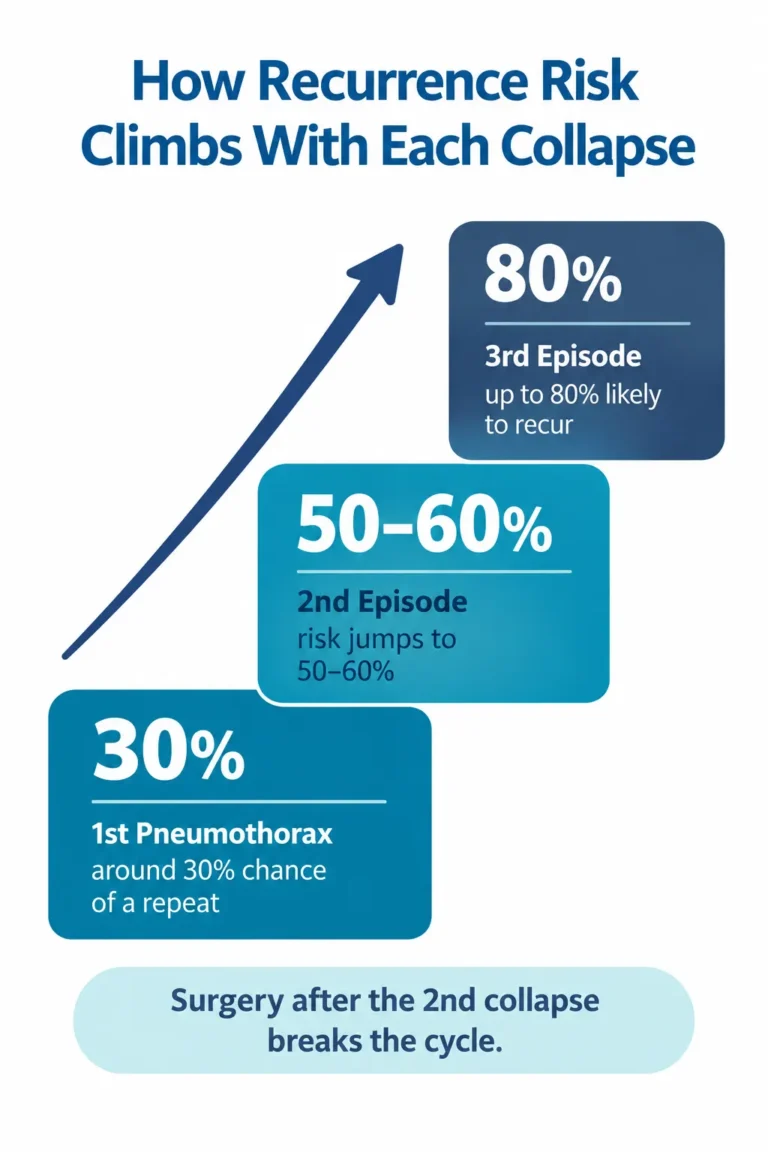
When air enters the space around the lung and compresses it, the result is a pneumothorax — a collapsed lung. A first episode can often be managed with observation or a chest drain, and most people recover without major intervention. However, when the same lung collapses a second time, the likelihood of further episodes rises considerably. That is when surgery moves from a distant option to the recommended course of action. A repeat collapse on the same side is a clear indication that the underlying problem needs to be addressed directly.
According to Dr. George Karimundackal, a leading Thoracic Surgeon in Mumbai, “A single pneumothorax is often managed conservatively, with a drain and close observation. But once the same lung collapses again, the recurrence rate climbs past 50 percent, and no drain changes that. Surgery is the only step that addresses the underlying blebs and reliably prevents the next episode.”
Why Does a Pneumothorax Keep Coming Back?
A lung does not collapse without a reason. There is usually an underlying cause, and that cause does not resolve on its own after the first episode.
The pattern tends to repeat because of the same structural problem: a weakened area on the surface of the lung that did not heal adequately. Blebs are the most common culprit. These are small, fragile air-filled sacs located at the edges of the lung tissue. When one ruptures, adjacent blebs remain at risk of doing the same. A chest drain resolves the immediate collapse, but it leaves the underlying blebs intact, where they can rupture again. Addressing this root cause is the primary purpose of surgery. Our VATS surgery page covers the keyhole approach in detail.
When Does Recurrent Pneumothorax Need Surgery?
Surgery is not automatically required after every collapse. What determines the need is the overall pattern rather than any single episode.
Second collapse, same side: A repeat episode on the same lung raises the recurrence risk significantly and is a standard indication for surgical intervention.
Persistent air leak: When air continues to escape from the lung despite a drain being in place, the leak needs to be closed directly.
Collapse on the opposite lung: When the other lung is also affected, the risk profile changes, and surgical management becomes more important.
High-risk occupations: Pilots, divers, and individuals whose work makes a sudden lung collapse particularly hazardous may be considered for surgery earlier than the standard threshold.
The procedure involves two to three small incisions. The faulty blebs are removed, and the lining of the lung is attached to the chest wall so it cannot separate again. Recovery is generally straightforward, and recurrence following surgery is uncommon. Because no chest procedure is entirely without risk, our post on VATS surgery risks explains what patients can expect.
Why Choose Dr. George Karimundackal?
Dr. George Karimundackal is among India’s leading thoracic surgeons, with over 15 years in the field. Before his current post as Director, Thoracic Surgery at Nanavati Max Hospital, he was Professor of Thoracic Surgery at Tata Memorial Hospital in Mumbai. Keyhole surgery for recurrent pneumothorax is a regular part of his practice, and every case is planned to address the underlying cause and reduce the risk of another collapse, not just treat the current episode.
Frequently Asked Questions
Can a pneumothorax heal without surgery?
A first, small collapse often does, with oxygen or a drain. Repeat episodes usually need surgery.
How successful is recurrent pneumothorax surgery?
Very. Keyhole bleb removal with pleurodesis drops recurrence to under 10 percent.
How long is recovery after pneumothorax surgery?
Most people leave hospital in two to four days and return to light activity within a couple of weeks.
Can the lung collapse again after pneumothorax surgery?
It’s uncommon. Bleb removal with pleurodesis seals the lung lining to the chest wall, dropping the chance of another collapse on that side to under 10 percent.
Disclaimer: This blog is for informational purposes only and isn’t a substitute for professional medical advice; please consult a specialist for diagnosis and treatment.