This website is being reviewed and updated in line with the National Medical Commission (NMC) guidelines on ethical advertising and public communication by registered medical practitioners.
This website is being reviewed and updated in line with the National Medical Commission (NMC) guidelines on ethical advertising and public communication by registered medical practitioners.
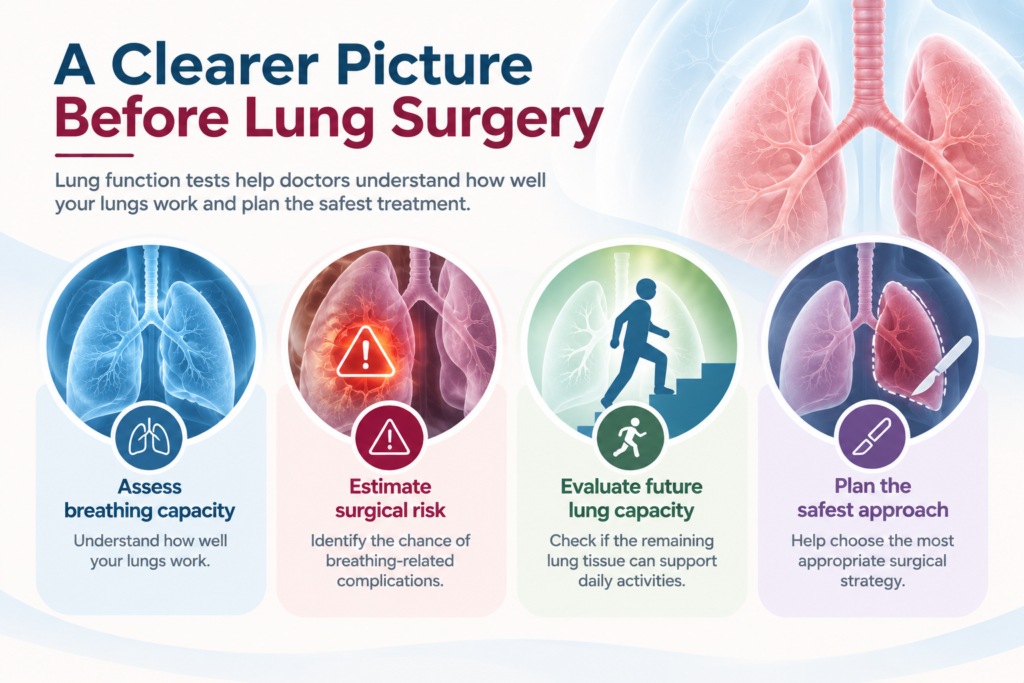
Doctors need to understand the state of your lungs as well as their ability to sustain the breathing process, prior to conducting the surgery. In other words, lung function tests before lung surgery aim to evaluate your breathing capacity, oxygen transfer and the risks of postoperative complications. These tests are particularly important when there is a necessity to remove some part of the lung to treat conditions such as lung cancer.
According toDr. George Karimundackal, assessment of your lungs is an important step in planning safe and effective surgery. The information received during the tests will allow the surgical team to estimate your respiratory reserve and determine whether it is necessary to conduct further testing, preparation, or an
Dr. George Karimundackal is a highly qualified and experienced thoracic surgeon in Mumbai specializing in the evaluation andsurgical management of lung conditions. Understanding your test results will help you take proper steps regarding treatment and recovery.
Why Are Lung Function Tests Needed Before Lung Surgery?
Pulmonary function tests before surgery determine your lungs’ efficiency in movement of air and transferring oxygen into the bloodstream.
These are helpful in:
These tests are particularly crucial before excision of a part of, or whole, lungs.
Not every patient needs the same tests. Here are the main assessments doctors may recommend.
Which Lung Function Tests Are Done Before Lung Surgery?
Spirometry: Understanding FEV1 and FVC
The spirometry test determines the amount of air that can be breathed out and the rate at which the person can exhale.
FEV1: The amount of air that is exhaled within one second of forced breathing.
FVC: Forced volume of air that can be exhaled after a deep breath.
This will determine any airflow obstruction in the lungs and evaluate their capacity. Understanding of FEV1 before lung surgery will help doctors know how breathing might change after the procedure.
DLCO Test: Measuring How Well the Lungs Transfer Oxygen
The diffusing capacity of the lungs for carbon monoxide (DLCO) measures lungs’ efficiency in passing gases into the bloodstream.
A DLCO test before surgery can provide information about gas exchange that spirometry alone cannot provide. This is important since the patient can have reasonable airflow but reduced oxygen transfer capacity.
Exercise Testing Before Lung Surgery
Some patients undergo walking tests, stair climbing assessments or cardiopulmonary exercise testing (CPET).
This is done to determine how the heart and lungs function during physical exertion. They may be recommended when there is an indication of a lack of respiratory reserve from previous test results or when the surgical team needs a more detailed assessment of exercise capacity.
Preparing for lung surgery?
Discuss your pulmonary function tests with your surgeon to understand your respiratory reserve and the next steps.
Your results reflect more than just your lungs. Let’s look at what can influence them.
What Factors Can Affect Lung Function Test Results?
Some factors that might influence the outcomes of lung function tests include:
* Smoking history and exposure to air pollution.
* Being asthmatic or having chronic obstructive pulmonary disease or other chronic lung conditions.
* Recent respiratory tract infection.
* Age, height, and physical fitness.
* Anaemia and other medical conditions, especially concerning DLCO measurement.
* How well you follow the instructions during testing.
The measurements are always interpreted alongside your complete medical record, imaging scans, etc., not the numbers alone.
What Do FEV1 and DLCO Results Mean Before Lung Surgery?
FEV1 helps assess airflow, while DLCO measures gas-transfer efficiency. These tests are usually performed against the predicted value, depending on the age, height, and gender of the person.
Low values may indicate a reduced respiratory reserve and higher risk of developing complications. However, there is no particular value that determines surgical fitness for every patient.
The type of procedure, symptoms, physical abilities, and other health problems of patients are taken into account when doctors recommend to undergo surgery.
How Do Doctors Calculate Lung Function After Lung Surgery?
Predicted postoperative FEV1 and DLCO estimate how well the lungs may function after the planned resection.
Doctors will look at the patient’s results as well as the percentage of functioning lung tissue that would be left following the surgery. This will vary depending on the type of surgery, and they could count segments or use imaging to estimate the contribution of the tissue being removed.
These estimates help assess surgical risk and determine whether further exercise testing is needed. They also support discussions about the extent of surgery and possible alternatives.
The testing process is usually straightforward. Here’s what you can expect.
What Happens During a Preoperative Lung Function Assessment?
During a preoperative lung function assessment, you may be asked to:
Follow the laboratory’s instructions about medications, smoking, meals, and physical activity before testing. Tell the team about your current symptoms and any inhalers you use.
Follow the laboratory’s instructions about medications, smoking, meals, and physical activity before testing. Tell the team about your current symptoms and any inhalers you use.
Low results do not automatically mean surgery is impossible. Let’s look at how doctors assess your options.
Can You Have Lung Surgery if Your Lung Function Is Low?
When lung function is reduced, the team evaluates the risks of surgery against the benefits of treating the underlying condition.
How Can You Prepare for Lung Surgery if Your Lung Function Is Reduced?
A few practical steps may help you prepare. Here’s what to discuss with your care team.
Stop smoking as early as possible and seek support if needed.
Follow prescribed treatment for existing lung conditions.
Participate in recommended breathing exercises or pulmonary rehabilitation.
Maintain balanced nutrition and appropriate physical activity.
Attend follow-up appointments and complete all recommended tests.
These measures may improve your readiness for surgery, although individual results vary. Follow your surgeon’s advice about which activities are safe for you.
Frequently Asked Questions
1. Why are lung function tests needed before lung surgery?
To evaluate breathing function, the efficiency of gas exchange and the risk of having postoperative respiratory complications.
2. What is the normal value for FEV1 before lung surgery?
Each patient has their own normal value. Doctors compare the measured FEV1 to its expected value taking into account the nature of surgery and general condition of the patient.
3. What is a DLCO test before surgery?
The DLCO test evaluates the efficiency of gas transfer between the lungs and blood.
4. What is the predicted postoperative lung function?
This is an estimation of breathing capacity after removal of a certain portion of the lungs.
5. Can lung function improve before surgery?
Yes, sometimes lung function can be improved by stopping smoking, better treatment and rehabilitation.