- Have any questions?
- 085913 90567
- drgeorgechestdiseases@gmail.com

What Is a Thymoma and Does It Need Surgery?

Found a Spot on Your Lung? A Thoracic Surgeon’s Honest Take on Nodules
June 15, 2026
What Is Tracheal Stenosis and How Is It Treated?
July 4, 2026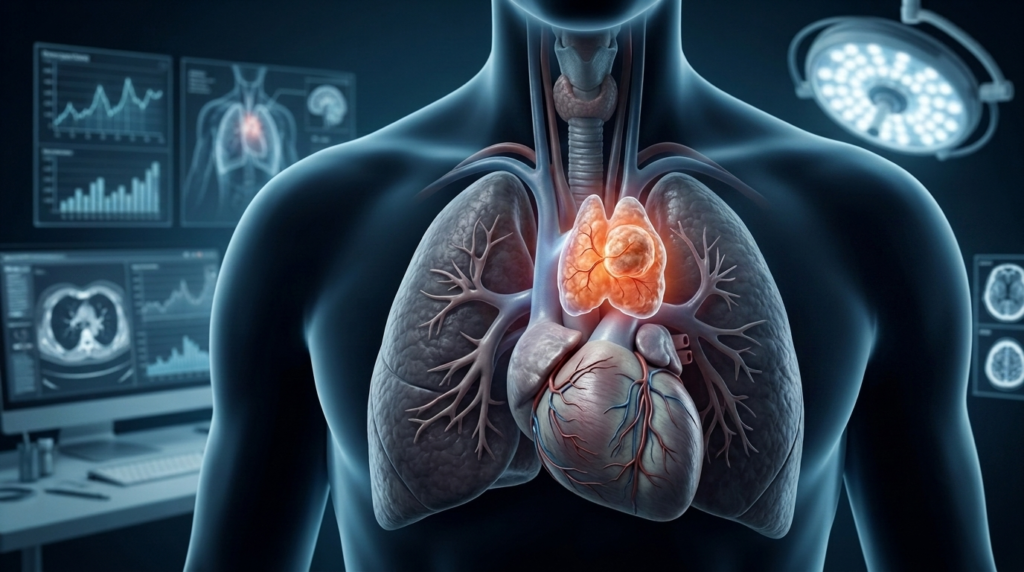
A thymoma forms in the epithelial cells of the thymus gland, sitting behind the breastbone in the anterior mediastinum. It’s the most common tumour found in that part of the chest, roughly one in four mediastinal masses. Growth is usually slow. Patients hear that and assume it can wait. It can’t, not indefinitely. Given enough time a thymoma pushes into the lung, the pericardium, the vessels running past it, and in a small number of cases it turns into thymic carcinoma, which is a much harder tumour to operate on.
According to Dr. George Karimundackal, a leading Thoracic Surgeon in Mumbai, “People think slow growing means there’s no urgency. Sometimes that’s fine. But a thymoma caught early is a clean operation with good long term survival. Catch the same tumour a year later, once it’s grown around a vessel, and you’re looking at a completely different surgery. Timing matters more than most patients realise.”
What Are the Symptoms and How Is Thymoma Diagnosed?
Many thymomas cause no symptoms at all and turn up by accident on a scan done for something else.
- Incidental finding: no symptoms whatsoever, the mass just gets found on an unrelated scan. Catching it early still gives a better surgical result than waiting.
- Chest heaviness and breathlessness: breathlessness that worsens lying flat, a dull chest ache, or a dry cough that won’t respond to antibiotics.
- Myasthenia gravis: affects 30 to 50 percent of patients. Drooping eyelids, double vision, weakness building through the day. A new MG diagnosis always warrants a CT chest to rule out thymoma.
- SVC syndrome: facial swelling, puffy arms, visible neck veins. A later sign that needs urgent imaging.
CT chest with contrast maps the tumour, and once a mediastinal mass is flagged, a proper surgical evaluation should begin with a consultation for mediastinal surgery.
Does Every Thymoma Need Surgery and What Does It Involve?
Surgery is the standard treatment for resectable thymoma at every stage, with complete resection driving long term outcome.
- Stage I and II: curative in most Stage I cases. Stage II with early capsular involvement still goes to primary surgery, with five year survival around 91 percent and ten year survival closer to 74.
- Stage III and IVA: chemotherapy often comes first to shrink the tumour enough for a clean resection, and the operation itself is more involved.
- Minimally invasive approaches: VATS or robotic thymectomy for early, non invasive thymomas at experienced centres, with outcomes comparable to open surgery.
- Thymectomy for MG without thymoma: removing a normal thymus still helps when medication stops working, with 30 to 40 percent reaching full remission.
Every decision here needs a proper multidisciplinary review, and understanding how thymoma differs from thymic carcinoma is covered in thymoma vs thymic carcinoma.
Why Choose Dr. George Karimundackal?
Dr. George Karimundackal, MBBS, MS (General Surgery), MCh (Surgical Oncology), MRCS Edinburgh, is Director of Thoracic Surgery at Nanavati Max Super Speciality Hospital, Mumbai. Fifteen years working exclusively in thoracic surgery, over a thousand minimally invasive procedures, and published research specifically on thymic tumour behaviour and thymoma linked myasthenia gravis. That kind of mediastinal experience is uncommon outside dedicated thoracic oncology centres. Every thymoma case here goes through a full tumour board review before any surgical plan is finalised.
Frequently Asked Questions
Yes. Thymoma is classified as a malignant tumour, though a low-grade one. It rarely spreads to distant organs, but it can invade nearby structures if left untreated, which is why it always requires proper evaluation and treatment.
Surgery is standard when the tumour is resectable. Chemotherapy or radiation come in only when surgery isn’t possible, or alongside it in advanced cases.
For Stage I and II thymoma with complete resection, five-year survival is around 91 percent and ten-year survival around 74 percent. Survival is lower at Stage III and IV, where treatment is more complex.
In about 30 to 50 percent of cases, yes. Removing the thymus often resolves or significantly improves these symptoms.