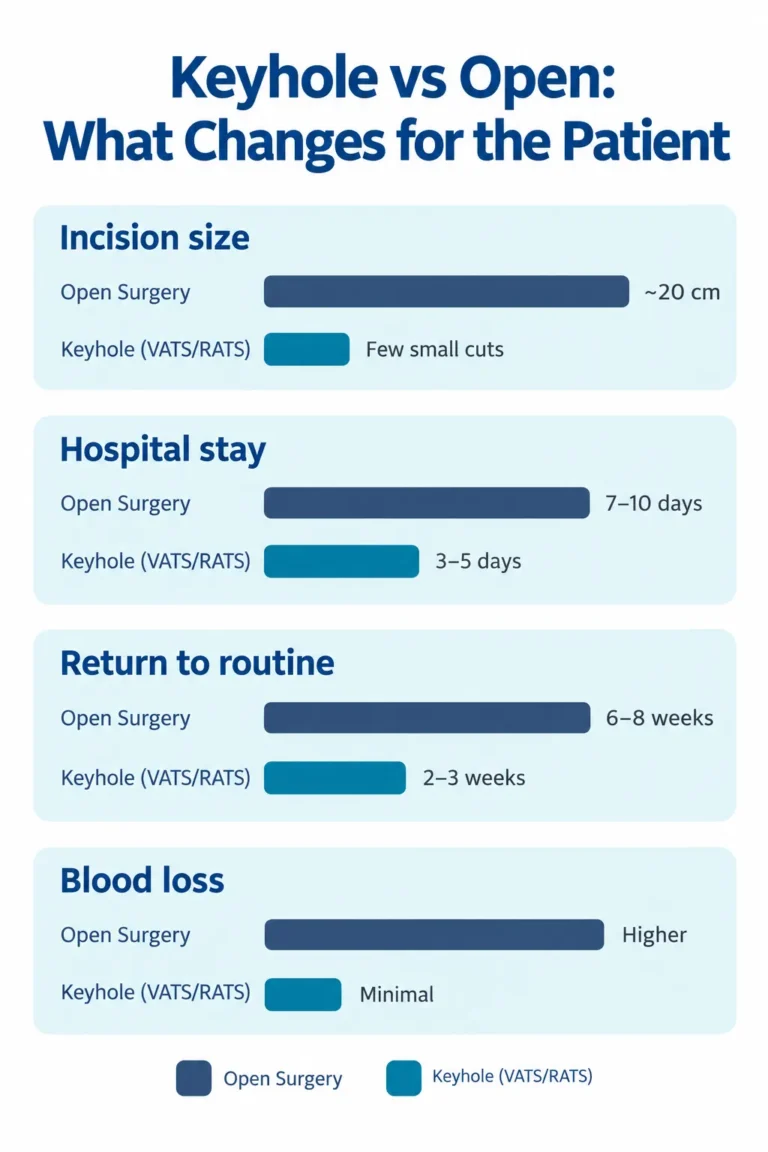
Go back twenty years and chest surgery came with a long incision and ribs spread apart. Recovery was prolonged, and the procedure carried significant physical demand. Most of that is behind us now. Two keyhole methods, VATS and RATS, are now the preferred approaches in chest surgery, and for early lung cancer they have largely replaced open surgery for these indications. Tiny cuts. No gaping wound. The one thing that separates them? What’s guiding the surgeon’s hands once the instruments are inside.
According to Dr. George Karimundackal, a leading Thoracic Surgeon in Mumbai, “Patients often ask which is superior, VATS or RATS. Truthfully, both are strong minimally invasive options. The real question is which approach fits the tumour, the patient’s anatomy, and the person in front of me, rather than crowning one the default winner.”
What Makes VATS and RATS Different from Open Surgery?
Trade a single big wound for a couple of small ones, and the whole recovery takes on a different character. That shift is bigger than most people expect.
Bars on a chart can’t quite capture it. Less pain, a lower risk of chest infections, and getting back to ordinary life sooner, that’s what the small cuts of keyhole surgery can really buy you. Work, the stairs at home, and daily activities that matter to you.. And if it’s cancer being removed, the keyhole approach can remove the tumour and lymph nodes just as in open surgery, only without the large incision in the chest wall. Want the full picture of what keyhole chest surgery handles? Our VATS surgery page has it.
VATS vs RATS: How Do the Two Compare?
Same keyhole approach, different machinery in the room. Here’s the point they part company.
Feature
VATS
RATS
Control
Surgeon holds instruments directly
Surgeon steers a robotic console
Vision
High-definition 2D or 3D camera
Magnified, stable 3D view
Cost
Lower
Higher
Best for
Most routine chest procedures
Complex or tight-space dissection
Hands-on or console-driven: VATS puts the instruments straight in the surgeon’s grip through the ports. RATS places the surgeon at a console nearby, controlling the robotic arms instead.
Steadier reach: Those robotic arms bend at angles a human wrist won’t manage, and that edge shows in tight spaces around delicate structures such as blood vessels.
Money does come into it: Robotic surgery costs more to run, so VATS is a more practical choice for straightforward cases.
Results sit close together: Recovery and cancer outcomes are mostly comparable. The deciding factors tend to be how experienced the surgeon is, the complexity of the case, and the patient’s anatomy.
Every operation carries a bit of risk, and understanding the possible complications means you can raise sharper questions well before the day arrives. Our post on VATS surgery risks covers the ground.
Why Choose Dr. George Karimundackal?
Dr. George Karimundackal is among India’s foremost thoracic surgeons, with 15 years of experience and more than 1,000 minimally invasive procedures. He previously held the position of Professor of Thoracic Surgery post at Tata Memorial Hospital in Mumbai, and is now Director of Thoracic Surgery at Nanavati Max Hospital. Whether a case calls for VATS or RATS, he decides one patient at a time, guided by what the tumour characteristics and patient anatomy require.
Frequently Asked Questions
Is RATS better than VATS?
Not automatically. RATS offers advantages in complex dissections involving tight anatomical space, while VATS handles the everyday cases just as capably.
Does robotic surgery mean a robot operates on me?
No. Every single movement is driven by the surgeon at the console; the robot only mirrors what their hands do.
Which has a faster recovery, VATS or RATS?
Much the same for both, generally a hospital stay of three to five days.
Is minimally invasive surgery safe for lung cancer?
Yes. Both remove the tumour and lymph nodes as thoroughly as open surgery, with less trauma.
Disclaimer: This blog is for informational purposes only and isn’t a substitute for professional medical advice; please consult a specialist for diagnosis and treatment.