- Have any questions?
- 085913 90567
- drgeorgechestdiseases@gmail.com

Aspergilloma Surgery: Who Needs It and Why?

Lung Cancer Screening: Who Should Get a Low-Dose CT Scan?
September 15, 2026
Coughing Up Blood? Could It Be Aspergilloma?
October 3, 2026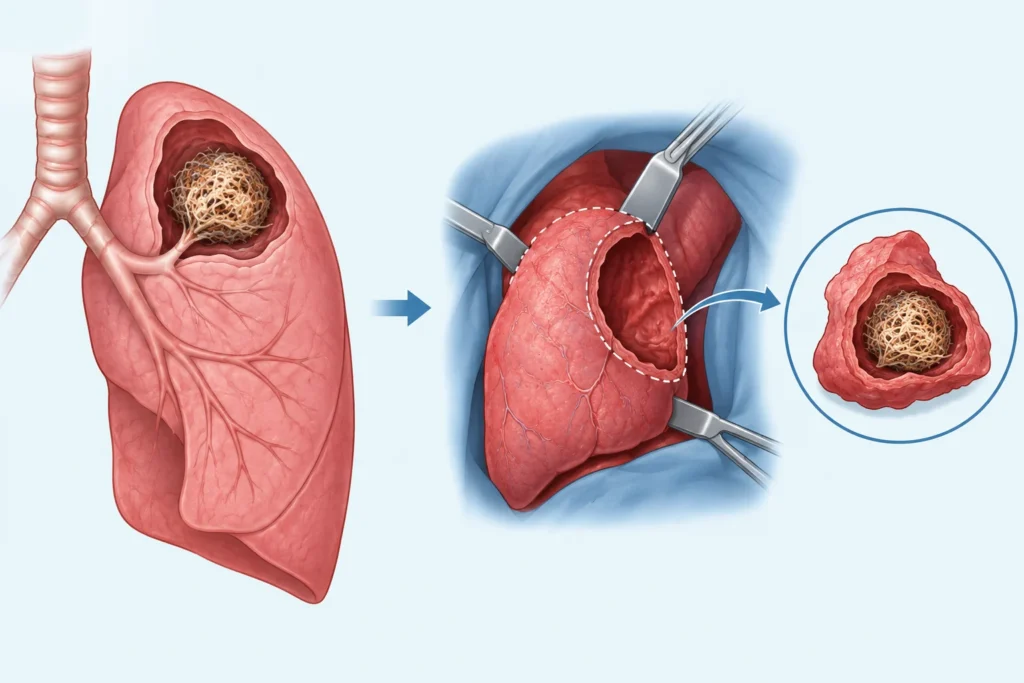
Not every aspergilloma needs an operation. Plenty of fungal balls sit quietly in the lung for years without causing serious trouble. An aspergilloma is a mass of Aspergillus mould that grows inside an existing cavity in the lung, most often one left behind by pulmonary tuberculosis or another chronic lung condition. And once it starts bleeding, or once the cavity that houses it keeps expanding, surgery becomes the most reliable answer.
According to Dr. George Karimundackal, a Thoracic Surgeon in Mumbai, “The decision to operate isn’t about the fungal ball alone. It’s about what it’s doing. A stable, silent aspergilloma in someone with limited lung reserve may simply get monitored. But the moment haemoptysis becomes recurrent, or the imaging shows a growing cavity, the balance tips firmly toward surgery. Waiting at that point rarely works in the patient’s favour.”
Who Actually Needs Aspergilloma Surgery?
Surgery isn’t the default for every aspergilloma diagnosis. Several specific situations push the treatment decision firmly in that direction.
- Recurrent haemoptysis: repeated episodes of coughing up blood are the most common reason to operate. Antifungal therapy doesn’t reach the fungal mass in useful concentrations, and embolisation controls bleeding only temporarily. Surgery removes the source.
- Enlarging fungal ball: a cavity growing between scans starts crowding whatever healthy lung sits next to it. Stay with it too long and the resection gets harder, the margins tighter, and protecting the surrounding tissue during surgery becomes a real problem.
- Risk of massive bleeding: some aspergillomas sit right next to large bronchial vessels. No active bleeding doesn’t mean the risk isn’t there. That anatomical position alone can be reason enough to take it out in a patient who’s fit for surgery.
- Failed antifungal therapy: antifungals tried properly, and the infection still isn’t clearing. Swapping to another agent rarely shifts the outcome at that point. Surgery is where the treatment goes next.
Severity, lung reserve, and where the cavity sits on imaging are what decide the right path. The non-surgical options are covered in full on the aspergilloma treatment page.
What Does Aspergilloma Surgery Actually Involve?
No two resections follow the same plan. Where the cavity sits, how stuck the walls are, and what’s around it shape the surgical approach before anything else.
- Pre-operative preparation: CT findings, Aspergillus serology, lung function, and nutritional status all get looked at before a date goes in the diary. Chronic infection runs some patients down considerably, and sorting nutrition out beforehand genuinely changes how the operation goes.
- Choice of surgical approach: VATS may be suitable for accessible cavities, offering smaller incisions and faster recovery. Dense adhesions, extensive disease, or high bleeding risk may make open surgery the safer option
- The resection itself: the cavity and its fungal contents are removed as a lobectomy, segmentectomy, or occasionally a wedge resection depending on what the anatomy allows. Keeping the fungal material contained during removal is critical. Spillage into the pleural space raises the risk of postoperative infection considerably.
- Recovery and follow-up: most patients are home within three to five days after a VATS resection. An antifungal course post-operatively is added in some cases. Follow-up CT scans check for any residual infection and confirm clearance.
Aspergilloma treatment surgery outcomes often depend on timely intervention. Our post on aspergilloma symptoms covers what to watch for before the surgical conversation becomes necessary.
Why Choose Dr. George Karimundackal?
Dr. George Karimundackal is one of India’s leading thoracic surgeons with over 15 years of experience. He was previously Professor of Thoracic Surgery at Tata Memorial Hospital in Mumbai before taking up his current role as Director, Thoracic Surgery at Nanavati Max Hospital. Aspergilloma surgery can be technically demanding, requiring careful planning based on CT imaging, lung function, and disease extent. VATS may be suitable for selected patients, while open surgery may be necessary in more complex cases.
Patients leave the consultation knowing whether surgery is the right next step, what it involves, and what recovery actually looks like.
Frequently Asked Questions
Yes, it can be. A sudden large bleed from an aspergilloma is sometimes fatal.
Surgical removal of a simple aspergilloma gives most patients a lasting cure.
Five-year mortality for untreated chronic aspergillosis can reach 80 percent.
Costs differ by centre and procedure; best confirmed at a surgical consultation.
References
- Surgical treatment for pulmonary aspergilloma: early and long-term results: https://pmc.ncbi.nlm.nih.gov/articles/PMC5519834/
- Surgical treatment of aspergillosis by video-assisted thoracoscopy: https://pmc.ncbi.nlm.nih.gov/articles/PMC10159685/
Disclaimer: This blog is for informational purposes only and isn’t a substitute for professional medical advice; please consult a specialist for diagnosis and treatment.