
VATS Surgery (Video-Assisted Thoracoscopic Surgery) in Mumbai, India
Thoracic conditions like pleural effusion, lung cancer, emphysema, and mediastinal masses frequently need surgical correction, and how that surgery is done matters as much as the decision to operate. Open chest surgery was, for decades, the only path forward, but the field has changed.
“Most patients who come to me expecting a large scar and months of recovery are surprised to learn they can go home within a few days,” says Dr. George Karimundackal, a globally renowned thoracic surgeon in Mumbai. “Minimally invasive thoracic surgery has changed what recovery looks like for a large number of chest conditions.”
Dr. George Karimundackal has extensive expertise in lung resections, pleural surgery, and mediastinal procedures. For patients searching for VATS Surgery (Video-Assisted Thoracoscopic Surgery) in Mumbai, India, Dr. George brings the oncologic precision and minimally invasive technique that complex thoracic cases demand.
Not sure what VATS actually involves? Let’s explore the procedure and why it has changed thoracic care.
What is VATS Surgery?
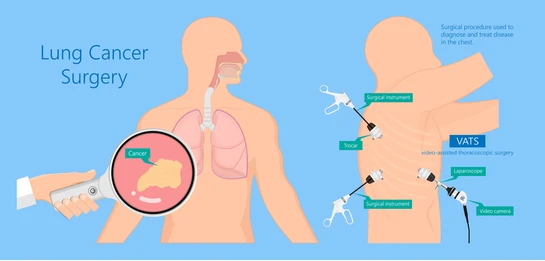
Video-Assisted Thoracoscopic Surgery, or VATS, is a minimally invasive surgical approach to operating inside the chest cavity. Instead of a long incision that splits the ribcage open, the surgeon makes two or three small cuts, typically less than a centimetre each, and inserts a tiny camera called a thoracoscope along with thin surgical instruments. The camera sends a magnified, high-definition image to a monitor, letting the surgeon see and work inside the chest without separating the ribs.
The contrast with conventional open thoracotomy is significant. Open surgery requires a 15-25 cm incision, spreading of the ribs, and a recovery period that can stretch to six weeks or more. VATS achieves the same surgical goals with far less trauma to the chest wall. Most patients experience less pain, shorter hospital stays, and a quicker return to normal activity.
Which chest conditions qualify for this approach? Let’s discover the diagnoses that respond well to VATS.
Conditions Treated with VATS Surgery
VATS is used across a wide range of thoracic diagnoses. Dr. George Karimundackal, regarded as one of the best thoracic surgeon for VATS in India, commonly performs VATS for:

Lung Cancer
Early-stage lung cancer and tumors can be removed with VATS to avoid a major chest incision.

Pleural Diseases
Conditions such as pleural effusion, pleuritis, and pleural biopsies can be managed using this minimally invasive method.

Benign Lung Tumors
Non-cancerous tumors in the lungs can be successfully removed with reduced trauma.

Collapsed Lung (Pneumothorax)
VATS can treat a collapsed lung by removing air and repairing any tears in the lung tissue.

Esophageal Disorders
VATS is also used to treat conditions such as achalasia and esophageal cancer by providing access to the chest cavity with minimal invasiveness.

Lung Biopsy
For suspected lung cancer or other diseases, VATS allows for an accurate biopsy with smaller incisions.
What changes when you choose VATS over open chest surgery? Let’s dive into the advantages that make it a preferred choice.
Benefits of VATS Surgery
The advantages of Video-Assisted Thoracoscopic Surgery over open chest surgery are well-documented:
Smaller incisions
Two to three cuts instead of one large opening means far less scarring
Significantly less pain
The chest wall is not spread, which is the primary source of post-operative pain in open thoracotomy
Shorter hospital stay
Many patients are discharged within two to four days
Faster recovery
Return to light activities within two to three weeks in most cases, compared to six to eight weeks with open surgery
Lower risk of infection
Smaller wounds reduce exposure
Preserved lung function
Surgical trauma to the surrounding tissue is minimal
Better cosmetic outcome
Particularly relevant for younger patients and women For patients who are also receiving chemotherapy or radiation as part of a cancer treatment plan, a faster surgical recovery means less time before those adjuvant treatments can begin.
Not every chest condition automatically qualifies for VATS, so who does? Let’s discuss the criteria for a suitable candidate.
Who is a Candidate for VATS Surgery?
Good candidates for VATS include patients with:
- Early to intermediate-stage lung cancer (Stage I-II, and selectedStage III)
- Recurrent or persistent pneumothorax
- Pleural disease requiring drainage, biopsy, or pleurodesis
- Mediastinal massesthat have not invaded surrounding structures
- Undiagnosed lung nodules requiring biopsy
- Good baseline lung function
VATS may be less suitable for patients who have had previous chest surgery with significant adhesions, those with very large tumours in difficult anatomical locations, or patients with severely compromised lung function.
In these cases, Dr. George Karimundackal evaluates each situation individually to determine if VATS Surgery in India is the best option. The goal is always the best oncologic and functional outcome, not simply the least invasive approach for its own sake.
What happens in the operating room during a VATS procedure? Let’s delve into each stage so you know what to expect.
VATS Surgery Procedure: Step-by-Step
Step 1: Pre-operative assessment
Before any surgery, Dr. George Karimundackal reviews your imaging, pulmonary function tests, and overall fitness. Blood work, ECG, and anaesthesia review are completed in advance.
Step 2: Anaesthesia
VATS is performed under general anaesthesia. A specialized technique called single-lung ventilation is used, in which one lung is slightly deflated to give the surgeon space to work inside the chest.
Step 3: Port placement
Three small incisions, usually between the ribs, are made. A thoracoscope is placed through one port. Instruments enter through the other two.

Step 4: Surgery
Using the thoracoscope's camera feed, Dr. George performs the procedure, whether it is removing a lobe of the lung, draining fluid, or excising a mass. The magnified view often gives better visibility than in open surgery.
Step 5: Chest drain placement
A temporary drain is placed before closing the ports to help the remaining lung re-expand and remove any residual fluid or air.
Step 6: Recovery
The patient moves to recovery, then to the ward. Chest physiotherapy begins early, often the next morning, to help lung expansion and prevent complications.
Ready for a detailed consultation? Reach out today to discuss your procedure and recovery plan.
What risks should you realistically be aware of before surgery? Let’s discuss the possible complications and how they are managed.
Risks and Complications of VATS Surgery
Like any surgery, VATS carries some risks, but they are minimal compared to traditional open surgery. These risks may include:
- Infection at the incision sites
- Bleeding
- Damage to surrounding organs (rare)
- Pneumothorax (lung collapse) during surgery
- Anesthesia-related complications
Dr. George Karimundackal, ranked as one of the best Video Assisted Thoracoscopic Surgery Doctor in Mumbai, discusses all applicable risks with patients during the pre-operative consultation.
What do the weeks after VATS actually look like? Let’s explore the recovery timeline so you can plan ahead.
Recovery After VATS Surgery
Hospital stay typically ranges from two to four days for most procedures, though complex resections may require a few additional days. The chest drain is removed once the lung has fully re-expanded and air leak has stopped, usually within 24 to 48 hours for simpler procedures.
At home, patients are advised to:
- Avoid lifting anything heavier than two to three kilograms for the first two weeks
- Walk daily from the first week, gradually increasing distance
- Attend follow-up appointments at one week, four weeks, and as scheduled based on diagnosis
- Avoid driving until pain is well controlled and you can perform an emergency stop without hesitation
Most patients return to desk work within two to three weeks. Physical jobs take longer, typically four to six weeks. For lung cancer patients, oncology follow-up begins shortly after surgical recovery.
Looking for the best care for your VATS surgery in India? Here’s what makes Dr. George the ideal choice for your treatment.
Why Choose Dr. George Karimundackal for VATS Surgery?
15+ Years of Thoracic Surgery Experience
Dr. George is one of the most experienced thoracic surgeons in India, with a high volume of minimally invasive chest procedures performed annually.
Full Spectrum of Thoracic Surgery
From straightforward pneumothorax repairs to complex lung cancer resections, every case is handled with the precision that VATS demands.
1,000+ VATS Procedures Performed
With over a thousand minimally invasive thoracic surgeries completed, the level of technical precision brought to each case is backed by real, high-volume experience.

Evidence-Based Practice
As one of the best thoracic surgeons for VATS in India, Dr. George actively participates in clinical research and training, ensuring his techniques reflect the latest surgical evidence.
Proven Success
Having successfully performed numerous VATS procedures, Dr. George is known for delivering consistent, excellent results with reduced complications.
High Safety Standards
Every procedure follows strict pre-operative, intra-operative, and post-operative protocols, backed by institutional support from a nationally accredited hospital.
Don’t wait to get the care you deserve. Get in touch today and take the first step towards a faster, safer recovery with expert VATS surgery.
Don’t wait to get the care you deserve. Get in touch today and take the first step towards a faster, safer recovery with expert VATS surgery.
Frequently Asked Questions
Post-operative pain is much lower than with open chest surgery because the ribs are not spread. Most patients manage comfortably on oral painkillers within two to three days of the procedure.
Duration depends on the specific procedure. A diagnostic biopsy may take 30 to 45 minutes, while a lobectomy for lung cancer typically takes two to three hours.
Domestic travel by road or train is generally safe two to three weeks after discharge. Long-haul air travel is typically cleared at the four to six-week follow-up, depending on recovery.
Yes. Multiple studies over two decades confirm that VATS lung resection for early-stage lung cancer achieves the same oncologic outcomes as open surgery, with fewer complications and faster recovery. Dr. George performs VATS lobectomy and segmentectomy for appropriate lung cancer cases routinely.
Both are minimally invasive. VATS uses a camera and hand-held instruments. Robotic surgery adds a mechanical arm system controlled by the surgeon at a console. Both approaches have comparable outcomes for most thoracic procedures.
Disclaimer: The information shared in this content is for educational purposes and not for promotional use.